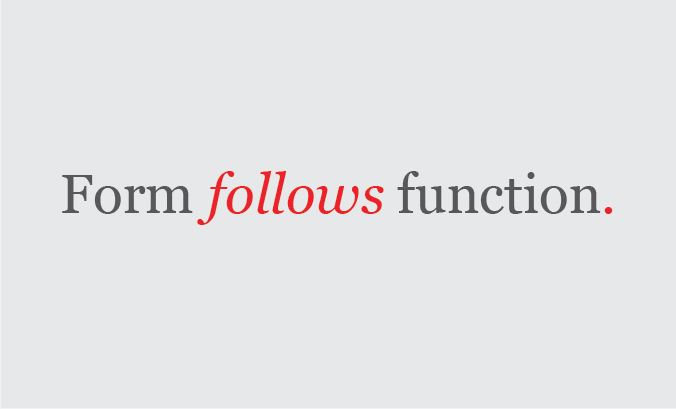
There is a much quoted phrase, originally coined by an American architect, that ‘form follows function’, although the phrase originally ran ‘form ever follows function’. The meaning of this being that the style of a building should be determined by its purpose.
The same principle has since been applied in any number of fields – some with more success than others. In the world of printed communications it’s an important maxim which still holds and although often stated, is not always followed.
Consider the following fictitious scenario:
The marketing manager for a housing association decides that they need to communicate important information to their tenants about the property they are renting. They find a freelance designer and ask them to quote for the design and print of a 12pp A5 booklet. The designer works up a design for the booklet showing their proposed handling of images and copy. It looks great – so eye-catching with all those big pictures, and the production costs are very reasonable. Promising to send the designers the content to drop in, he contacts his copywriter to write the content. To make it easier for them he also sends over the design which he’s annotated – ‘tenancy regulations to go here’ and ‘what to do if you get behind on your rent to go there’. The allocated spaces aren’t very big, but the copywriter does a great job of condensing lots of information into a very few words, and by making the text a little smaller, and the lines a little closer together, the designers are just about able to squeeze everything in.
This is an example of function following form. The end result may well be an ideal size to post, very cost effective to produce, and look impactful and professional overall (the form), but will it function properly? Will the tenants be able to find, understand, and apply the information that they need, bearing in mind their potential social demographic, and that English may not be their first language. Does the design enhance the message – emphasising the most important elements, and helping to clarify the information? It is possible, but unlikely.
Now consider the alternative scenario:
Just as before, the marketing manager for a housing association decides they need to communicate important information to their tenants about the property they are renting. This time, however, he gathers all the relevant information, and asks a designer and a copywriter to help him communicate the message in the clearest possible way. They talk about the sorts of problems which tenants regularly experience, and the sorts of questions they most often ask. These are the queries which take up most of the marketing manager’s staff’s time. The copywriter goes away and writes clear copy which answers the needs of the audience. Once agreed, the designer then presents that copy in a way which clarifies it further using typographic size and hierarchy, placement, graphic devices, colour and images. Almost the final decision is to determine what page size is best suited to present this information, and how many pages will be needed.
Now we have an example where the form of the publication is a direct result of the function. Every element has been created or chosen in order to clarify and enhance the message. The words on the page have been written and presented specifically to answer the precise needs of the target audience. The end result might still be a 12pp A5 brochure, but nothing has been compromised in order to achieve this. And the cost of the process – hiring a copywriter and a designer – is no greater, but far greater value will have been extracted from both.
And the best part of working this way? The marketing manager may well find that the repeated queries that take up so much of his staff’s time are no longer an issue, and that they are free to concentrate on providing an exceptional service.
This sort of approach is increasingly referred to as ‘design thinking’, but using design skills to help make business processes more effective and efficient is an approach which has long been effective.
Do you need a fresh perspective?
To chat about how I could help you use design thinking to make your communications more effective and efficient, please send me a message.
Get in touchRelated posts
 Recent posts
- Accessible PDF heading structure and the problem of phantom headings
- Accessible colour contrast for text
- How we can work together on accessible PDFs
- Acronyms & initialisms
- The best fonts for accessibility
Featured posts
Briefing a designer
Eight reasons to use freelance creatives
Putting a freelance designer at the heart of your project

Hello! I’m Sarah, an independent typographic designer.
I’ve been sharing my knowledge about design, typography, marketing, branding and printing since 2014. I hope you enjoy reading my blog.

Sarah Cowan